REVIEW · SWAKOPMUND
City Tour of Historical Swakopmund
Book on Viator →Operated by Kallisto Tours & Services · Bookable on Viator
Swakopmund feels like Germany on the Namib coast. This City Tour of Historical Swakopmund strings together six German-era landmarks in about 2 hours, with a guide who connects the buildings to the town’s harbour-and-colony story. I love how Historical Swakopmund gives you quick orientation without dragging you through a long day.
The standout for me is the guiding—Hans-Dieter brings clear explanations and a personal touch, and the small group size (max 25) keeps things relaxed. One possible drawback: it’s still a walking-focused route, so wear comfortable shoes and expect to stand outside for short stretches.
In This Review
- Key Highlights You’ll Really Notice
- Why This Historical Swakopmund Walk Works in Real Life
- Getting Started at Swakopmund Museum (And Staying in the Old Center)
- Woermannhaus on Bismarck Street: More Than a Pretty Building
- Swakopmund Jetty: The Atlantic’s Long Memory
- Prinzessin-Rupprecht-Heim: From Military Hospital to Red Cross Care
- Hohenzollernhaus (Haus Hohenzollern): German Ornamental Ambition
- German Evangelical Lutheran Church: Worship, Bells, and a Very Human Story
- Marine Memorial: A Monument With Specific Names and Dates
- Price and Value: What $37.16 Buys You Here
- What It’s Like With Hans-Dieter as the Guide
- Who This Tour Suits Best (And Who Might Prefer Something Else)
- Should You Book City Tour of Historical Swakopmund?
- FAQ
- How long is the City Tour of Historical Swakopmund?
- How much does the tour cost?
- Where does the tour start and end?
- Is pickup included?
- How big are the groups?
- Do I need tickets or extra entry fees for the stops?
- Can I cancel and get a full refund?
Key Highlights You’ll Really Notice
- Fachwerk architecture at Woermannhaus in Bismarck Street, plus details like the Damara Tower lookout.
- A hard-to-break jetty story: the 1912 iron structure, cut short by World War I, but built to endure the Atlantic pounding.
- Prinzessin-Rupprecht-Heim’s life changes from military hospital to convalescent home, then Red Cross renovations.
- Haus Hohenzollern’s standout ornamentation: cupids, flowers, lions, and an Atlas motif.
- Marine Memorial craftsmanship honoring the First Marine Expedition, cast and designed with impressive specificity.
Why This Historical Swakopmund Walk Works in Real Life
Swakopmund is one of those towns where the buildings do half the storytelling for you. The other half is making sense of what you’re looking at—why this place has that German colonial look, and why the harbour mattered so much. This tour is built for that exact job: a focused, about-2-hour route through the historical core.
I also like the pacing. You’re not rushing between random photos. Each stop has a purpose—trading, shipping, hospitals, worship, memorials—so you end up with a mental map of how the early settlement worked. And the guided explanations make the architecture feel less like trivia and more like a timeline you can see on the streets.
You can also read our reviews of more city tours in Swakopmund

Getting Started at Swakopmund Museum (And Staying in the Old Center)
You’ll meet at the Swakopmund Museum on Strand Street (the listed meeting point is Swakopmund Museum, 8GFF+Q62, Strand St). From there, the tour keeps you in the historical part of town, and you finish back at the same meeting point.
This matters because a lot of Swakopmund sightseeing can feel scattered—beach views here, shops there, then you realize you’ve walked around without really understanding the German-era footprint. Here, your guide keeps the route coherent, and you’ll generally spend your time on buildings tied directly to the town’s early harbour role and German colonial presence.
Also, pickup is offered, which is a small but real convenience if you’re not staying right near Strand Street. And since the tour is near public transport, you’re not stuck if you plan your day with buses or taxis.
Woermannhaus on Bismarck Street: More Than a Pretty Building

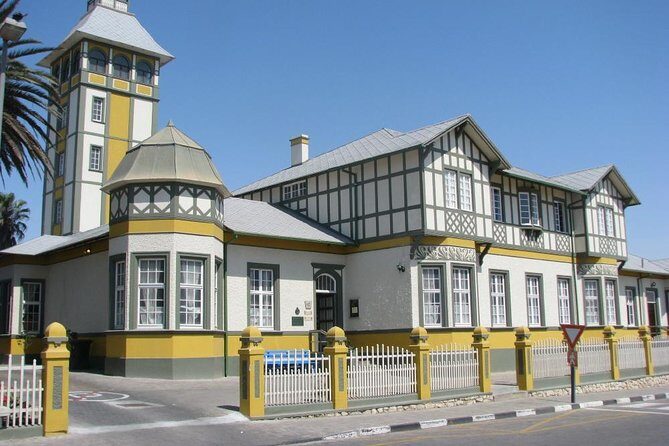
The tour’s first stop is the Woermannhaus on Bismarck Street, and it’s an excellent anchor point because it tells you what kind of power ran Swakopmund early on: trading. The building was erected in 1894 by the Damara and Namaqua Trading Company, then extended in 1903 and 1904 when wood-panelled offices were added.
What I’d pay attention to here is the architectural approach called Fachwerkbau, linked to architect Friedrich Höft. Fachwerk isn’t just decorative. It signals a construction language associated with that German building style tradition—so you’re literally seeing how settlers built their systems into the landscape.
A few details that give the place extra meaning:
- The courtyard was once filled with an evergreen garden.
- The building served as headquarters for the leading trading company in what was then South West Africa.
- There was also a Damara Tower on the north-west corner, described as a lofty lookout that doubled as a flag-mast and navigation point.
So yes, you’re looking at a historic building—but you’re also seeing how commerce, administration, and navigation were physically connected in the early town.
Swakopmund Jetty: The Atlantic’s Long Memory
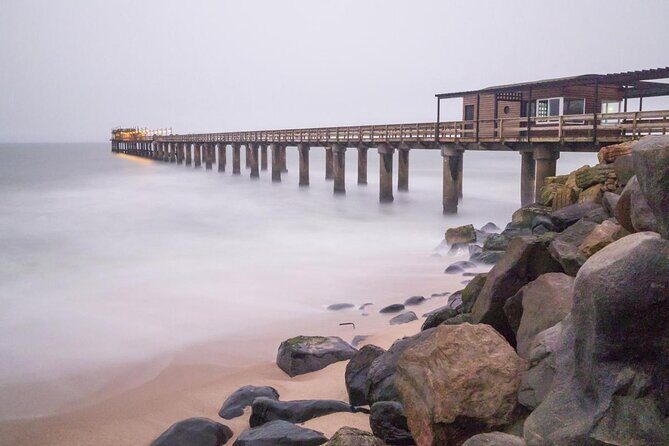
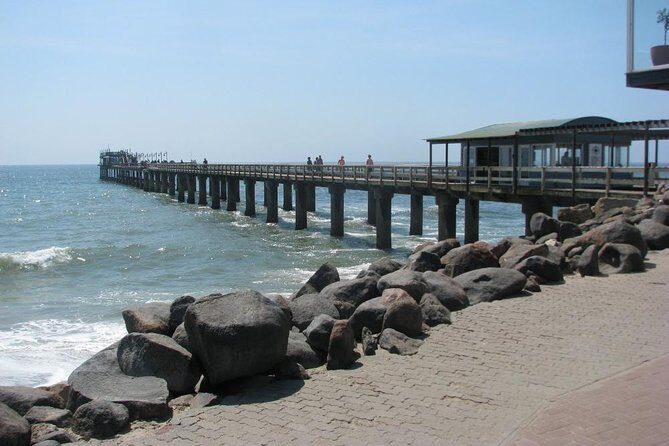
Next comes the Swakopmund iron Jetty, constructed in 1912 as a replacement for a wooden jetty that had become derelict. This is a stop I love for two reasons: you learn the engineering challenge, and you learn how history interrupts plans.
Plans were made to build a jetty of 640 meters. But the rocky area caused major difficulties during construction, so the contractors had to develop and incorporate a drilling programme to handle the obstacles. Then World War I broke out, and the jetty was left uncompleted and extended to only 262 meters.
Here’s the part you’ll appreciate most when you picture it: the jetty was built to such high standards that it endured the Atlantic’s pounding for over 70 years, requiring little or no repair. That’s not just a historic fact—it’s a clue about the seriousness of the harbour economy.
Time on this stop is short (about 15 minutes), but it’s enough to connect the jetty to the town’s role as a main harbour location, including the fact that the earlier structures—the mole and later the jetty—still exist.
Prinzessin-Rupprecht-Heim: From Military Hospital to Red Cross Care
The tour then moves to Prinzessin-Rupprecht-Heim, built in 1902 and named after Prinzessin Rupprecht, associated with the Bavarian Association and the wife of the heir to the Bavarian throne. Even if you’re not a building-nerd, this stop hits because it shows how quickly one function can change in a growing settlement.
Originally, it was occupied as a military hospital in 1902. In 1909, the hospital closed and the building was converted into a convalescent home by 1911. Later, the Bavarian Women’s Association of the Red Cross took over and commissioned extensive renovations with a donation of 35,000 mark.
That story adds a human layer to the German colonial setting you’re seeing elsewhere. This isn’t only about commerce and monuments. It’s about how institutions cared for people in the early years.
You’ll spend about 20 minutes here. Admission is free, and that matters because the stops are built as a walkable cultural circuit, not as a paid checklist of separate attractions.
You can also read our reviews of more historical tours in Swakopmund



Hohenzollernhaus (Haus Hohenzollern): German Ornamental Ambition
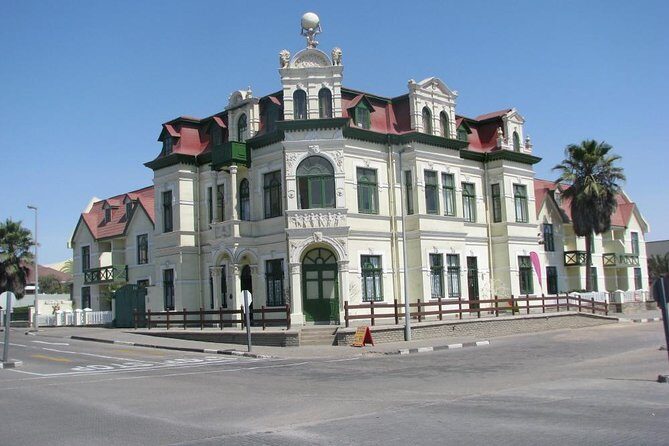
Stop four is Haus Hohenzollern, also called Hohenzollernhaus, built between 1904 and 1906. The tour describes it as a former hotel and one of Swakopmund’s most extraordinary buildings, and once you’re standing near it, you understand why.
What to look for:
- Cupid and flower adornments
- A corner pediment edged off with two lions
- An imperial image of Atlas holding the world on his shoulders
The angle I like here is that the town’s early pioneers created buildings with a level of ornament that doesn’t feel accidental. The tour notes how, despite the harshness of the Namib Desert, builders managed to create enduring architecture. It’s a useful reminder that the German-era presence wasn’t just a set of practical structures. They also aimed for style, drama, and status.
Time is about 15 minutes, so don’t try to read every architectural detail at once. Instead, let the whole composition register first, then focus on one or two motifs like Atlas or the lions.
German Evangelical Lutheran Church: Worship, Bells, and a Very Human Story
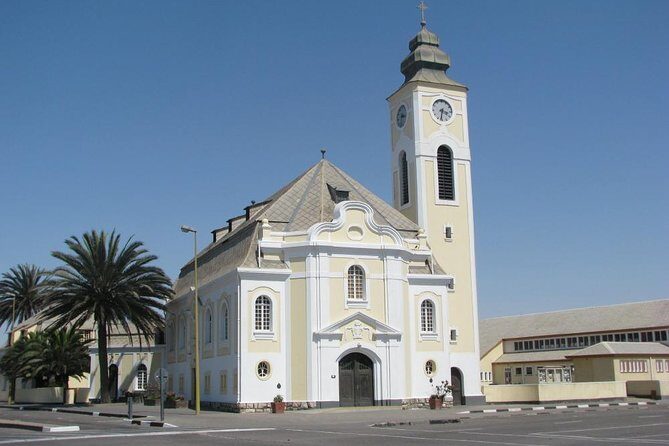
Now you move to the German Evangelical Lutheran Church with its adjacent parsonage. This is where the tour earns points for turning history into something you can picture.
There’s a story connected to 1905: Pastor Vedder is said to have been disappointed to find open-air church services completely unattended. He supposedly returned home to a wooden crate without roof, doors, or windows—carrying the sermon still folded and unread.
Then in 1909, the congregation rallied to draw up building plans so they could build a proper church. The architect Ertl designed it in a Neo-Baroque style. The construction contract went to F. H. Schmidt in 1910 for 85,000 Mark. The bells were cast in Apolda, Germany by Franz Schilling.
Whether you believe every detail of the crate story doesn’t matter as much as what it signals: the church wasn’t just imported. It was assembled locally, against real obstacles, by people who wanted worship to be something more than wishful planning.
You’ll spend about 20 minutes at this stop, with free admission and an explanation that ties the building to the community effort behind it.
Marine Memorial: A Monument With Specific Names and Dates
The final stop is the Marine Memorial, dedicated to the members of Germany’s First Marine Expedition who were killed in action. The statue shows a marine standing beside his fallen comrade, and the monument is described as having superb detail.
This stop has crisp factual anchors that make it easy to remember:
- Designed by Berlin sculptor A. M. Wolff
- Cast by Gladenbeck A. G., Berlin
- Presented to Swakopmund by the crew of the gunboat Panther on 26 July 1908
- Declared a national monument by the National Monuments Commission on 2 January 1969
I like monuments like this when they’re not vague. Here, you get names, dates, and the chain of presentation that connects the town to a larger German naval story.
You’ll spend about 20 minutes here, and because this is the last stop, it works like a closing chapter: from harbour commerce and building ambition, to community institutions, to the memorial that outlives the people it honors.
Price and Value: What $37.16 Buys You Here
At $37.16 per person for a roughly 2-hour tour, the price feels fair because you’re paying for three things: guided interpretation, a tight route through major historic sites, and convenience.
Convenience counts. Pickup is offered, and you’re using a mobile ticket. Your group maxes at 25, which typically makes Q&A and pacing easier than on larger tours. Also, the stop admissions listed are free—so you’re not constantly reaching for your wallet at each building.
The best value isn’t just seeing six sites. It’s understanding how they connect. The guide’s job is to translate the town from architecture into story: trading company headquarters at Woermannhaus, industrial shipping at the jetty, institutional care at Prinzessin-Rupprecht-Heim, decorative power at Haus Hohenzollern, faith-building at the church, and the memorialization at the end.
If you’re the type who wants to see Swakopmund in fewer hours but with more meaning, this is a strong use of time.
What It’s Like With Hans-Dieter as the Guide
All signs point to the same thing: the guide matters here. Many guests specifically praised Hans-Dieter for clear, detailed explanations and for sharing historical tidbits that make the buildings more than scenery.
One review theme stands out: he brings a personal connection to Swakopmund, including family history tied to Germany and living in the area for a long time. In practice, that kind of local memory often helps you get answers faster when you’re curious about why something was built where it was—or why the town looks the way it does today.
You’ll also notice in the feedback that people appreciated how well he kept things organized and how prompt he was. That’s not a small thing during a short tour; timing is everything when your day already has other plans.
Who This Tour Suits Best (And Who Might Prefer Something Else)
This tour is ideal if you:
- Want a quick orientation to Swakopmund’s historical core
- Care about German colonial architecture and the stories behind it
- Prefer walking with explanation instead of self-guided wandering
You might choose something else if:
- You dislike standing outside during a walking route
- You’re looking for deep nature or beach time instead of historic buildings
- You want a full-day program; this one is designed to be short and focused
Should You Book City Tour of Historical Swakopmund?
Yes, you should book it if you want to understand Swakopmund in the time it takes to do dinner and still enjoy your evening. The route is concentrated, the stops are meaningful, and the guide’s explanations are repeatedly praised for clarity and detail—exactly what you need when a town’s look is strongly tied to one era and one set of influences.
If you’re on the fence, think of it this way: this tour helps you read the town like a map. Without the guide, Swakopmund can look like a collection of old buildings. With the guide, it becomes a connected story—from trading house to jetty engineering to churches and memorials.
FAQ
How long is the City Tour of Historical Swakopmund?
The tour lasts about 2 hours.
How much does the tour cost?
The price is $37.16 per person.
Where does the tour start and end?
It starts at Swakopmund Museum (8GFF+Q62, Strand St, Swakopmund, Namibia) and ends back at the same meeting point.
Is pickup included?
Pickup is offered.
How big are the groups?
The tour has a maximum of 25 travelers.
Do I need tickets or extra entry fees for the stops?
Admission at the listed stops is listed as free, and you’ll use a mobile ticket for the activity.
Can I cancel and get a full refund?
Free cancellation is available if you cancel up to 24 hours in advance for a full refund.