REVIEW · WALVIS BAY
Moonlandscape & Welwitschia Drive
Book on Viator →Operated by Photo Ventures Namibia - Day Tours · Bookable on Viator
The Namib Desert plays tricks on your eyes. This small-group half-day tour links Walvis Bay Lagoon birdlife with otherworldly Namib scenery and ends with classic Swakopmund sea views. It’s a smart way to pack in several “wow” moments without spending the day bouncing around on your own.
I especially like two things: the tight small-group size (up to 8) and the mix of stops, from flamingos at the lagoon to Welwitschia Valley plants that look like they belong in a museum. You also get round-trip transfers from your Walvis Bay base, so you’re not wrestling with logistics.
One thing to consider: this is desert touring, and the route can kick up dust. If you have dust allergies, plan for it with the right gear and mindset.
In This Review
- Key points worth knowing
- Why this Walvis Bay desert drive feels so different
- Price and logistics: what you’re really paying for
- Walvis Bay Lagoon: birds first, before the sand takes over
- Dune 7 off the C14: local picnic energy in stark sand
- Moon Landscape and the Swakop River Valley drive
- Welwitschia Valley: ancient plants with a survival story
- Swakopmund Jetty: a classic stroll with a real story
- The guide makes or breaks the day (and here, it’s strong)
- Timing, comfort, and what to bring
- Who this tour fits best
- Should you book Moonlandscape & Welwitschia Drive?
- FAQ
- FAQ
- How long is the Moonlandscape & Welwitschia Drive tour?
- What does the price include?
- How many people are in the group?
- Is hotel pickup available?
- Where does the tour start and end?
- What stops are included during the tour?
- Is admission included for the main attractions?
- What wildlife and plants can I expect to see?
- Is the tour suitable if I have a dust allergy?
- What is the cancellation policy?
Key points worth knowing
- Up to 8 people means your guide can actually answer questions and adjust the pace
- Walvis Bay Lagoon is a top wetland stop for flamingos and other migrating birds
- Dune 7 is a local picnic spot tucked beside the C14
- Moon Landscape + Swakop River Valley drive gives you wind-carved views in a short time
- Welwitschia Valley is your slow, plant-focused pause in the middle of sand and rock
- Swakopmund Jetty adds an ocean-side stroll with real historical detail behind it
Why this Walvis Bay desert drive feels so different
The Namib Desert doesn’t look like typical “sand and nothing else.” In this region, sand, rock, and sparse life all fight for attention at the same time. That’s exactly what makes this tour work so well as a half-day outing: it strings together scenes that feel unrelated until you realize they’re all part of the same system.
You start near Walvis Bay, where the lagoon acts like a magnet for birds. Then you head into the stark Namib terrain—first to Dune 7, then to the wind-eroded Moon Landscape, and finally to Welwitschia Valley, where plants have adapted in ways that look borderline unreal. You end with the familiar comfort of the sea at the Swakopmund Jetty, where the contrast is the point.
For photographers, this route is practical: each stop is built for quick framing opportunities—wide shots for dunes and the moonlike terrain, plus closer views for the plants and birds.
You can also read our reviews of more tours and experiences in Walvis Bay.
Price and logistics: what you’re really paying for
At about $144.54 per person for roughly 5 hours, you’re paying for access, guidance, and transportation all rolled into one. The value shows up in the basics: round-trip transfer from your Walvis Bay hotel base, a small group, and organized time at each of the key photo stops.
This isn’t a long, do-everything day. So instead of spending hours driving between locations yourself, you’re using a pre-set route with a guide who knows where to pause and what to watch for. That matters in the Namib, where distances can feel longer than they look on a map.
You’ll also get a mobile ticket, and your booking comes with confirmation. The meeting point is easy to find at the Walvis Bay Tourism Centre, at the corner of Union and 5th Road.
Walvis Bay Lagoon: birds first, before the sand takes over
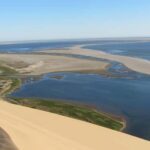
The tour begins at the Walvis Bay Lagoon area, which is one of the richest wetlands in southern Africa. Here, you’re not hunting for a single animal—you’re scanning for a whole mix: Great and Lesser flamingos, Damara terns, pelicans, avocets, and numerous migrant water birds.
This stop is more than a warm-up. Wetland birds give you a different kind of photography than dunes do. You can work with soft light, reflections, and long-range observation. And emotionally, it’s a nice reset: before you enter harsh desert conditions, you get to see life thriving at water’s edge.
Practical note: lagoon stops can mean you’ll be standing and looking for a while. If you’re the type who gets impatient waiting for birds to move, bring a little patience—and your binoculars if you use them.
Dune 7 off the C14: local picnic energy in stark sand
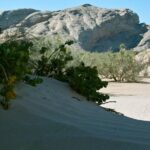
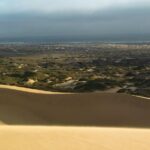
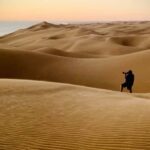
Next comes Dune 7, about 6 km by road from town off the C14. Even though it’s inside the Namib’s bleak-looking expanse, locals use the area as a picnic stop. That’s why you’ll notice the vibe here: it’s not just “look at a dune and leave.” There’s a sense of people making a day out of it.
The picnic site itself has been engulfed by sand over time, but it still offers shaded palm trees tucked into the lee of the dune. That shade detail is genuinely useful because it gives you a place to cool down, catch your breath, and regroup before the longer Namib walk/drive portion.
This is also a good stop for quick photos. You don’t need long trekking time to capture the feel of the dune—just a steady stance, a clean line of sight, and a willingness to shoot from slightly different angles as the light shifts.
Moon Landscape and the Swakop River Valley drive
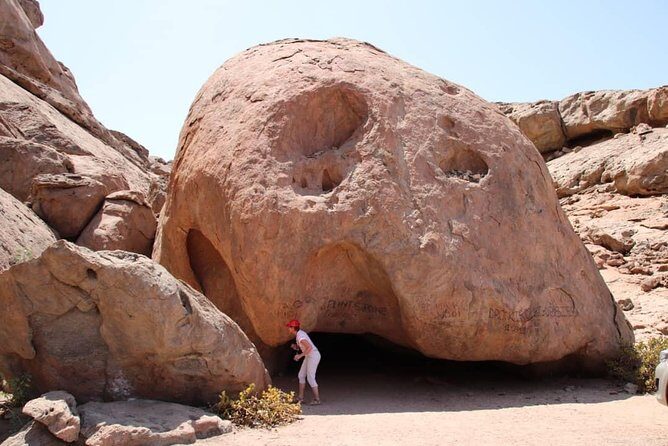
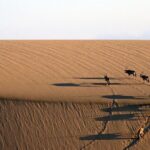
Then the tour leans hard into the “alien planet” feel: the Moon Landscape. The Namib is one of the oldest deserts in the world, and that age shows up in the forms—wind has been shaping rock and sand for a very long time.
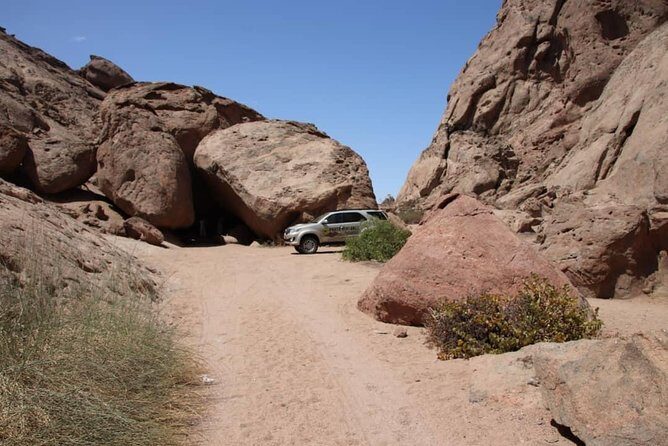
You drive through the Swakop River Valley and then into the Moon Landscape itself. The key idea is erosion. Mountains were reduced by wind and weather into rock formations and sand. The result is a valley that looks like a moonscape—sculpted, rough, and full of color shifts as the light hits different textures.
This stop is also where your walking expectations should match reality. The terrain is arid, so you’re moving slowly and carefully rather than hiking aggressively. Most people can handle it at a casual pace, but go in with the understanding that the ground isn’t forgiving.
If you’re into photography, this is where you’ll spend most of your time. Look for:
- strong lines and shadows in rock textures
- contrast between pale sand and darker rock
- small color variations across the ground surface
Welwitschia Valley: ancient plants with a survival story
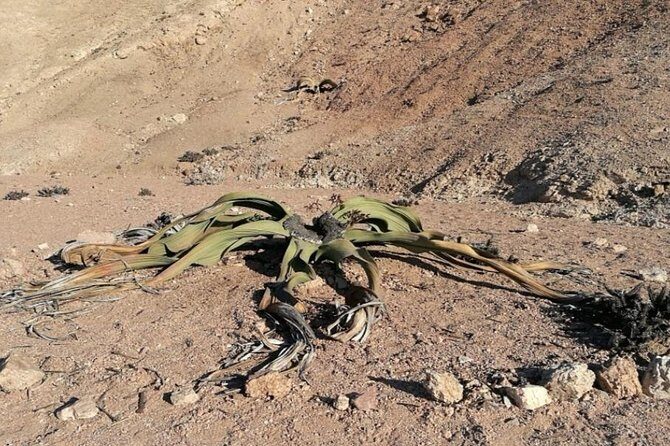
After the Moon Landscape portion, you head to Welwitschia Valley, where thousands of welwitschia plants are scattered across the area.
Welwitschia is the kind of plant you can’t stop staring at once you notice it. Its look is so unusual that it changes how you see the desert. Instead of thinking of the Namib as empty, you start realizing it’s designed to keep moisture and survive long dry stretches.
You’ll make a stop specifically to view these plants. That pause is valuable because it forces you to slow down and actually see the desert’s biology, not only its “wow” shapes. It’s one of those rare moments when the guide’s explanation can make the environment feel personal.
One small piece of advice: dress for sun and for dust. In this part of the tour, your body will feel the desert more than your eyes will.
Swakopmund Jetty: a classic stroll with a real story
You wrap up at the Swakopmund Jetty, with about 30 minutes to stroll and take in the views.
This jetty isn’t just a photo spot. It has a clear timeline:
- commissioned on 25 April 1905 at 275 m long and 9 m wide
- extended by 1907
- by 1911 it was planned to replace the wooden jetty with a steel one, with construction starting in 1912
- it became popular for anglers and leisurely walks
- it was considered unsafe and closed in 1983
- it reopened after repairs in October 2006
That history matters because it gives your walk a bit of context. You’re not just looking at a wooden walkway; you’re standing on something that has served multiple eras of Swakopmund life—and survived long enough to come back.
If you like the sea-air feeling after desert time, this stop is exactly for you. It’s also handy for a last set of photos before you head back.
The guide makes or breaks the day (and here, it’s strong)
The reviews consistently point to guide quality, especially the energy and clarity they bring to the desert. One reviewer highlighted Jenifer as friendly, informative, fun, and clearly passionate about the area. Another mentioned Christopher, who picked them up promptly and added early bird spotting (flamingos on the beach area) before the dune portion.
That matters because in places like this, you don’t want a “drive-by” guide. You want someone who can explain what you’re seeing—why a dune looks the way it does, why plants survive here, and what to watch for in the lagoon.
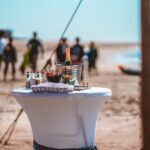
One review also notes a champagne lunch in the desert. I can’t promise that’s guaranteed for every departure based on the information here, but it does hint that the day can be a little more special than just sightseeing. Even without that, you should still expect a guide who keeps things light and engaging rather than stiff and lecture-heavy.
For your part, come prepared to ask questions. The tour format supports it, especially with a maximum of 8 people.
Timing, comfort, and what to bring
This is a half-day experience, roughly 5 hours, so you should plan for a full stretch rather than a slow museum pace. Short stops at Dune 7 and the jetty keep the day moving, while Moon Landscape and the plant valley take the heavier time.
Comfort-wise:
- Dust can be a factor, and the tour notes dust allergies as a consideration
- Morning or daytime sun can be intense on open sand and rock
- You’ll be switching between lagoon viewing, dune terrain, and a coastal stroll
What I’d bring (simple but useful):
- sunglasses and sun protection
- a light layer for cooler air near the coast
- something to reduce dust exposure if you’re sensitive
- a camera with a strap you don’t have to think about
If you want the best photos, work the edges of the light. Desert colors change fast, and the right angle can turn “okay” sand into a scene with texture.
Who this tour fits best
This is a strong pick if you want a one-day plan that checks multiple boxes:
- bird spotting at Walvis Bay Lagoon
- dunes without a tough hike
- a slow, plant-focused moment at Welwitschia Valley
- a scenic, low-effort finale at Swakopmund Jetty
It’s especially well-suited for photographers and nature lovers because the itinerary is built around seeing, not just passing.
If you’re traveling with limited time in Namibia, this kind of organized route can be a lifesaver. If you prefer total control and long stays in one place, you might want a different style of tour. But for most visitors who want variety in one compact day, this hits the right notes.
Should you book Moonlandscape & Welwitschia Drive?
Book it if you want a tight, guided circuit that shows you the Namib’s key personalities: dunes, wind-carved forms, and the plants that make the desert feel alive. With round-trip transfers, a small group, and stops that balance views with learning, it’s a good value way to experience a lot without exhausting yourself.
Skip it (or think carefully) if dust is a big concern for you or if you dislike any kind of outdoor walking on uneven sand and rock. Also, if you hate the idea of fixed time windows—20 minutes at Dune 7, about 30 minutes at the jetty—then you may prefer a longer, more flexible format.
If you’re standing at the start of a Namibia trip and wondering how to get the “real” feel quickly, this drive is an efficient, well-structured answer.
FAQ
FAQ
How long is the Moonlandscape & Welwitschia Drive tour?
The tour lasts about 5 hours.
What does the price include?
The tour price includes round-trip transfers from your Walvis Bay hotel area and the key tour visits. The Moon Landscape admission is included, and other specific stops have free admission.
How many people are in the group?
The tour has a maximum of 8 travelers.
Is hotel pickup available?
Yes—pickup is offered, with round-trip transfers from your Walvis Bay hotel.
Where does the tour start and end?
The meeting point is the Walvis Bay Tourism Centre at the corner of Union and 5th Road in Walvis Bay. The tour ends back at the same meeting point.
What stops are included during the tour?
The route includes Walvis Bay Lagoon (bird area), Dune 7, the Moon Landscape with a drive through the Swakop River Valley and a visit to Welwitschia Valley, and finally the Swakopmund Jetty.
Is admission included for the main attractions?
Moon Landscape admission is included. Dune 7 and Swakopmund Jetty are listed with free admission.
What wildlife and plants can I expect to see?
At Walvis Bay Lagoon, you can see flamingos and various water birds. At Welwitschia Valley, you’ll visit a site with thousands of welwitschia plants.
Is the tour suitable if I have a dust allergy?
Dust allergies are noted as a consideration. Most travelers can participate, but if you’re sensitive, you should plan accordingly.
What is the cancellation policy?
There is free cancellation. You can cancel up to 24 hours in advance for a full refund.